Your Surgical Center Is Audit-Ready — Until It Isn't
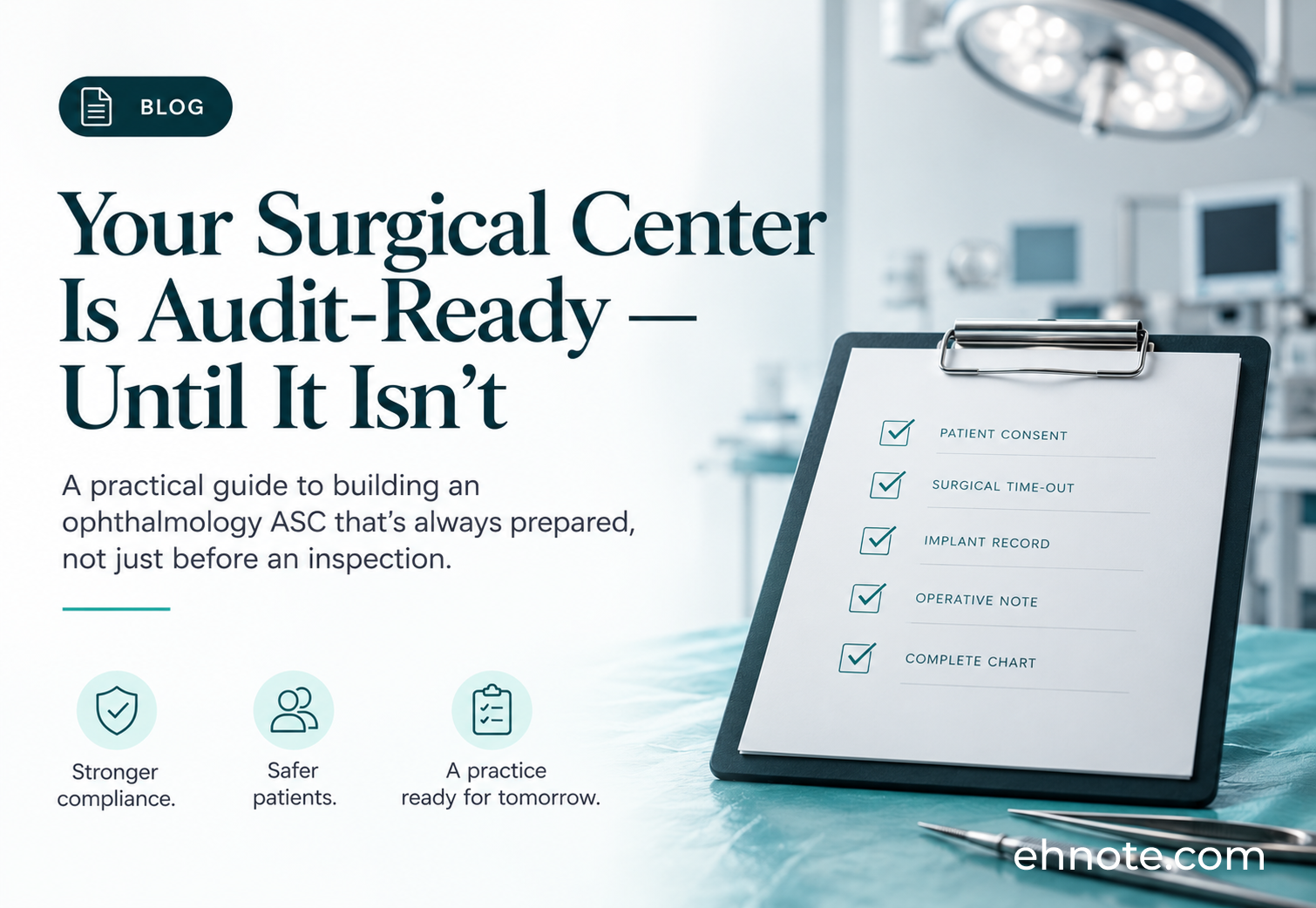
A practical guide to building an ophthalmology ASC that's always prepared, not just before an inspection.
An ophthalmology ASC can go years without a major compliance issue.
Surgeries run on time. Patients are happy. Surgeons trust their teams. Charts get completed. Accreditation certificates hang proudly on the wall.
From the outside, everything looks exactly as it should.
Then an auditor requests ten patient records.
Within an hour, the conversation changes.
An unsigned operative note. A missing consent acknowledgement. An incomplete surgical time-out. An implant record that doesn't fully match the operative documentation. None of these issues affected the patient's outcome. None were intentional. But together, they tell a story the practice never meant to tell.
That's the uncomfortable reality of ASC compliance.
Most ophthalmic surgery centers don't fail because they ignore regulations. They fail because small documentation gaps quietly accumulate over time—remaining invisible until someone starts looking for patterns.
The good news is that truly audit-ready ASCs don't achieve compliance by working harder. They achieve it by designing workflows that make compliance the natural outcome of everyday work.
Compliance Doesn't Collapse Overnight
When people think about compliance failures, they often imagine dramatic mistakes—a missing operative report, an incorrect procedure, or a major breach in protocol.
In reality, that's rarely how problems begin.
Compliance usually erodes one small decision at a time.
A surgeon plans to sign the operative note after the next case but gets pulled into another consultation. A circulating nurse forgets to complete one section of the surgical checklist during an unusually busy morning. A consent form is scanned into the patient's chart, but not linked correctly to the surgical encounter. Someone notices the issue later and assumes they'll come back to fix it.
Most of the time, nothing happens.
The surgery is successful. The patient goes home safely. The clinic moves on to the next case.
That success creates a dangerous illusion—that the documentation process is working just as well as the clinical process.
Until an audit proves otherwise.
Ophthalmology Creates a Different Kind of Documentation Challenge
General surgery centers perform a wide variety of procedures with different teams, different timelines, and different documentation requirements.
Ophthalmology is different.
Many ASCs perform dozens of cataract surgeries in a single day. Cases move quickly. Teams become highly synchronized. Every minute matters because even small delays can affect the entire day's schedule.
Ironically, this efficiency creates its own documentation challenge.
When the same workflow is repeated thirty or forty times in a day, people naturally develop rhythm. They anticipate the next step before the current one is finished. They rely on experience. They know what comes next.
That's excellent for surgical flow.
It's less forgiving for documentation.
Because documentation doesn't reward habit. It rewards consistency.
Every patient requires a complete record. Every procedure requires complete traceability. Every signature, verification, implant record, medication entry, and surgical checklist must stand on its own.
The hundredth cataract surgery of the month deserves the same documentation quality as the first.
What Auditors Are Really Looking For
One of the biggest misconceptions about regulatory audits is that inspectors are simply checking whether paperwork exists.
They're not.
They're evaluating whether documentation accurately reflects a repeatable clinical process.
In other words, they aren't asking:
"Is there an operative note?"
They're asking:
"Can this documentation demonstrate exactly what happened, who performed it, when it happened, and whether every required process was followed?"
That distinction changes everything.
A missing signature isn't just a missing signature.
It suggests the approval process isn't consistently enforced.
An incomplete surgical time-out isn't simply an unfinished checklist.
It raises questions about whether the verification process itself is standardized.
A missing implant record isn't merely incomplete documentation.
It challenges traceability—one of the most important principles in surgical quality and patient safety.
Auditors don't evaluate isolated mistakes.
They evaluate whether the system allows those mistakes to occur repeatedly.
The Documentation Gaps That Slip Through Most Often
Some documentation issues appear so minor that they're easy to overlook during a busy surgical day.
Electronic signatures completed hours after surgery instead of immediately following the procedure.
Time-out documentation that records the event but misses one required participant or verification step.
Implant information documented manually rather than captured directly through barcode verification.
Operative notes finalized well after the patient has been discharged.
Medication documentation completed retrospectively because the clinical team prioritized patient flow.
Each individual example seems manageable.
Collectively, they reveal something much more important.
The workflow depends on people remembering what still needs to be done instead of the system ensuring it happens before the case moves forward.
That's a workflow problem—not a people problem.
Good Teams Still Miss Things
This is perhaps the most important point.
Documentation gaps rarely happen because people don't care.
They happen because healthcare is cognitively demanding.
An experienced circulating nurse may coordinate twenty-five surgical cases before lunch.
A surgeon may move between the operating room, clinic, and postoperative consultations with barely a pause.
Administrators are simultaneously balancing staffing schedules, inventory, patient flow, payer requirements, and operational issues.
Expecting every member of that team to remember every documentation requirement every single time isn't realistic.
Nor should it be.
Healthcare has spent decades trying to solve workflow problems by asking people to be more careful.
The better solution is to reduce the number of things people must remember in the first place.
That's exactly what good systems are designed to do.
The Difference Between Being Compliant and Being Audit-Ready
These terms often get used interchangeably.
They shouldn't.
A compliant ASC meets today's documentation requirements.
An audit-ready ASC has operational processes that consistently produce compliant documentation every single day.
The distinction is subtle but profound.
In one environment, compliance depends on individual diligence.
In the other, compliance is embedded into workflow design.
The system won't allow an operative record to remain incomplete.
Required signatures are validated before documentation can be finalized.
Time-out documentation becomes a required checkpoint rather than an optional reminder.
Implant information flows directly into the surgical record instead of relying on manual transcription.
Audit trails are created automatically because every clinical action is already part of the digital workflow.
Staff members spend less time remembering what to document because the system guides them naturally through the process.
That doesn't just improve compliance.
It improves confidence.
Why This Matters Beyond the Audit
Regulatory inspections happen periodically.
Operational excellence happens every day.
That's why the most valuable outcome of strong documentation isn't simply passing an audit.
It's creating a more reliable surgical center.
Complete documentation reduces uncertainty during postoperative care. It strengthens communication between clinical teams. It simplifies billing. It improves implant traceability. It supports quality improvement initiatives. It creates cleaner data for reporting and analytics.
Most importantly, it allows surgeons and staff to focus their attention where it belongs—on patients instead of paperwork.
When documentation becomes a natural extension of clinical workflow instead of a separate administrative task, the entire organization becomes more resilient.
Audits simply become a by-product of that operational maturity.
The Future of ASC Compliance Isn't More Checklists
Healthcare has traditionally responded to documentation gaps by adding another checklist, another reminder, or another training session.
That approach has reached its limits.
Every new requirement increases cognitive load. Every additional manual process introduces another opportunity for inconsistency.
The future of compliance won't come from asking clinicians to remember more.
It will come from systems that quietly handle more in the background.
Purpose-built ophthalmology ASC platforms are already moving in this direction. Rather than treating compliance as something that happens after surgery, they build it directly into the surgical workflow itself. Required documentation, implant traceability, digital signatures, procedural checkpoints, and audit logs become part of how care is delivered—not tasks completed afterward.
The goal isn't to make audits easier.
It's to make audits uneventful.
The right path to be audit ready
Every ophthalmology ASC wants to deliver safe surgery, exceptional outcomes, and outstanding patient experiences.
Documentation should support that mission—not compete with it.
The strongest surgical centers aren't the ones that scramble before an accreditation visit or conduct last-minute chart reviews before an inspection.
They're the ones where every patient record is complete because the workflow leaves little room for anything else.
That's what being truly audit-ready looks like.
Not preparing for the day an auditor walks through the door.
Building a system where every day already meets the standard they'll be looking for.
Learn More About EHNOTE’s Ophthalmology EHR Software