Scaling an Ophthalmology Practice to Multiple Locations: The Systems Problem Your Growth Plan Is Missing
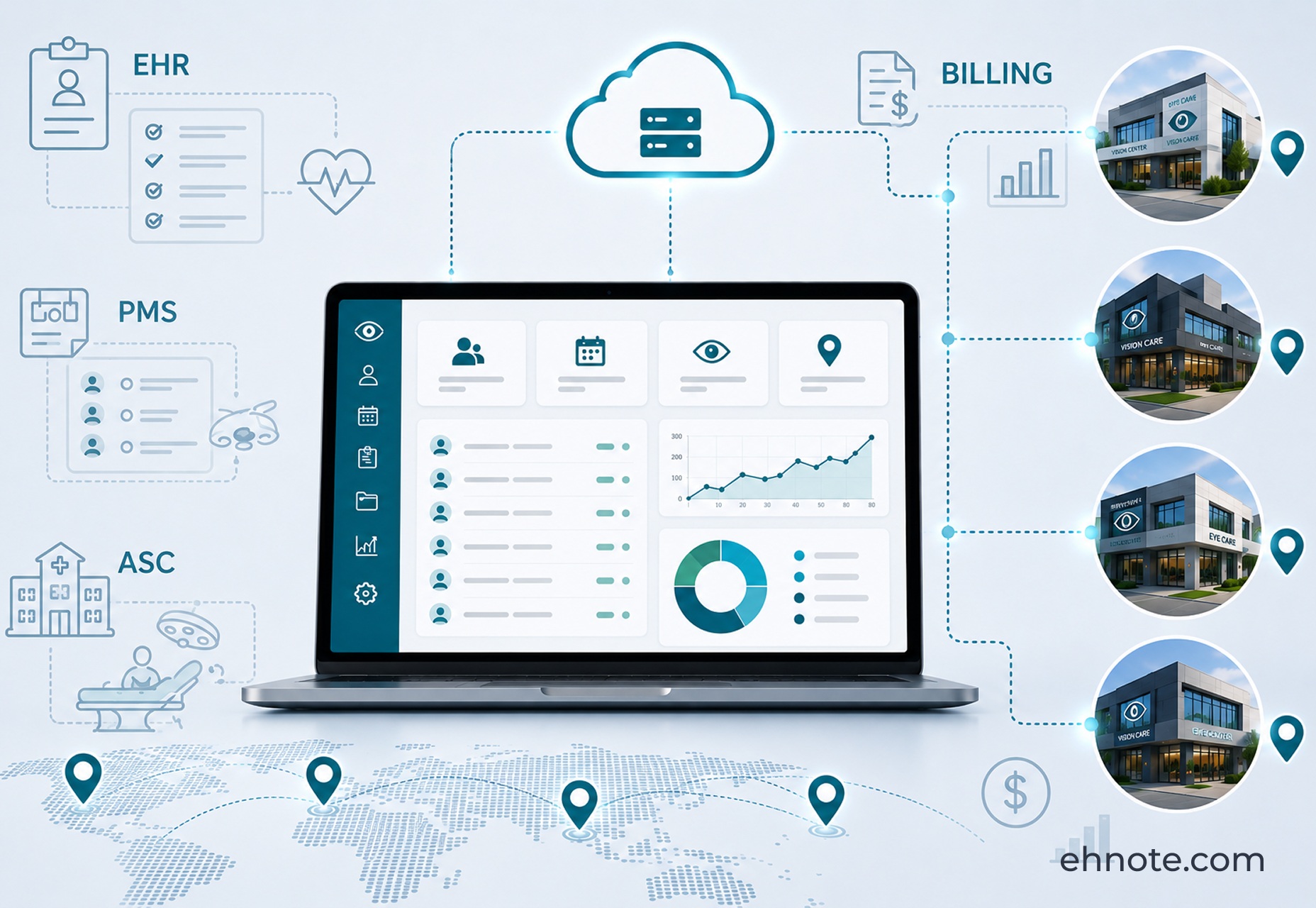
Most ophthalmologists think scaling means opening another location.
It doesn’t.
Opening another location is the easy part.
The hard part?
Making two locations feel like one practice.
Because here’s what nobody tells you about growth in ophthalmology:
The moment you move from one office to two, your software problems stop being annoying…
…and start becoming expensive.
Very expensive.
A scheduling mistake at one clinic suddenly affects physicians across two sites.
A missing patient history delays care in another office 40 miles away.
A billing issue no one notices in Location B quietly eats away at margins for six months.
And before long, leadership begins spending more time managing operational confusion than actually growing the practice.
I’ve seen it happen over and over again.
A successful single-location ophthalmology practice decides to expand. The demand is there. The physicians are strong. The patient base is loyal.
Everything looks right on paper.
And then the infrastructure starts cracking.
Not because the practice made a bad growth decision.
Because the systems underneath the practice were never designed for scale in the first place.
Here’s the Dangerous Assumption Most Practices Make
They assume the systems that worked for one location will continue working for three.
They won’t.
At one office, humans compensate for broken systems.
The front desk remembers things.
Technicians walk over and ask questions.
Managers manually fix scheduling conflicts.
Billing teams know where the gaps are.
The practice survives on proximity and tribal knowledge.
But when locations multiply, proximity disappears.
Now the organization depends entirely on infrastructure.
And fragmented infrastructure collapses fast.
The First Crack Usually Appears in Scheduling
At first, it doesn’t feel serious.
A patient accidentally gets booked into the wrong location.
A provider’s availability isn’t updated correctly across sites.
One office has open capacity while another is overloaded for weeks.
These seem like operational inconveniences.
They’re not.
They’re early signs the practice lacks centralized visibility.
And if scheduling breaks first, trust me — other things are already breaking underneath.
Because scheduling isn’t really about calendars.
It’s about operational coordination.
Once coordination weakens, friction spreads everywhere.
Then the Patient Experience Starts Splintering
This part gets dangerous.
Patients think they’re visiting the same organization.
But internally, the system behaves like separate businesses awkwardly stitched together.
A patient visits Location A for diagnostics.
Then shows up at Location B for follow-up.
But imaging doesn’t flow cleanly. Documentation is inconsistent. Staff members can’t immediately see the full clinical picture.
Now everyone slows down:
- the technician
- the physician
- the front desk
- the patient
And here’s the uncomfortable truth:
Patients may never understand the technical reason.
They just feel the disorganization.
The Billing Problem Gets Ugly at Scale
Single-location practices can sometimes “muscle through” fragmented billing systems.
Multi-location organizations can’t.
Because now you’re dealing with:
- different workflows between offices
- inconsistent documentation habits
- multiple reporting structures
- fragmented denial management
- separate financial visibility
Leadership starts asking basic questions that become surprisingly difficult to answer:
Which location is underperforming?
Which providers have rising denial rates?
Where is revenue leakage happening?
Why are collections slowing down in one office but not another?
Without centralized systems, finding those answers becomes painfully slow.
And delayed visibility is one of the most expensive problems in healthcare.
Because by the time you finally identify the issue…
…it’s already been happening for months.
Let Me Say Something Most Software Vendors Won’t
Integrations are not the same thing as unification.
This matters more than almost anything else.
A lot of growing ophthalmology practices try to solve scale by connecting separate systems together:
- one scheduling platform
- another EHR
- separate billing software
- external communication tools
On paper, they’re “integrated.”
In reality?
They still behave like disconnected products trying to cooperate.
Data syncs late.
Workflows overlap awkwardly.
Staff constantly switch between systems.
Reporting becomes fragmented.
The organization never truly operates as one.
And growth amplifies that weakness every single year.
The Practices Scaling Smoothly All Have One Thing in Common
No, it’s not private equity backing.
No, it’s not massive marketing budgets.
It’s operational continuity.
Their systems talk to each other because they were designed together from the beginning.
Scheduling flows across locations naturally.
Patient records follow the patient instead of staying trapped inside locations.
Leadership sees the entire organization in real time.
Staff members aren’t juggling five logins to complete one workflow.
The practice feels centralized — even when geographically spread out.
That changes everything.
Because Multi-Location Growth Is Really About Decision Speed
This is the part most physician-owners underestimate.
As organizations expand, decision-making becomes harder.
And fragmented systems slow decisions down even further.
By the time reports are compiled, the situation has changed.
By the time operational issues become visible, they’ve already spread.
By the time leadership reacts, revenue has already leaked.
Centralized systems compress that delay.
And in healthcare, faster visibility creates enormous competitive advantage.
Especially now.
Private Equity Is Changing the Rules of the Game
Across ophthalmology, consolidation pressure is rising fast.
Independent practices increasingly feel pushed toward one of two paths:
Grow.
Or eventually get absorbed by someone who already figured out how to scale operationally.
That’s the real battle happening underneath the industry right now.
Not clinical quality.
Not patient demand.
Infrastructure.
The independent practices surviving and growing successfully aren’t just adding locations.
They’re building operational systems strong enough to support expansion without chaos.
That distinction matters.
A lot.
And Here’s the Real Irony
Most practices don’t feel the full weight of fragmented systems until after they grow.
That’s when they realize:
- staff complexity exploded
- operational visibility disappeared
- workflows became inconsistent
- leadership lost clarityli
Growth exposed problems that were already there.
The systems simply hid them while the practice stayed small.
So What Does a Truly Scalable Ophthalmology Platform Look Like?
Simple.
Not simple in features.
Simple in operation.
One patient record across every location.
One scheduling ecosystem.
One billing infrastructure.
One operational view of the organization.
One system that allows leadership to understand the business in real time instead of reconstructing it from disconnected reports.
That’s what scalability actually looks like.
Not more software.
Less fragmentation.
The Bottom Line
Most ophthalmology practices think expansion means opening another office.
But expansion really means something much bigger:
Becoming an organization capable of operating coherently at scale.
And the practices that figure this out early gain a massive advantage.
Because once operational fragmentation spreads across multiple locations, fixing it becomes brutally difficult.
So before opening the next office…
Before recruiting the next physician…
Before planning the next phase of growth…
Ask a harder question:
Can your current systems actually support the organization you’re trying to become?